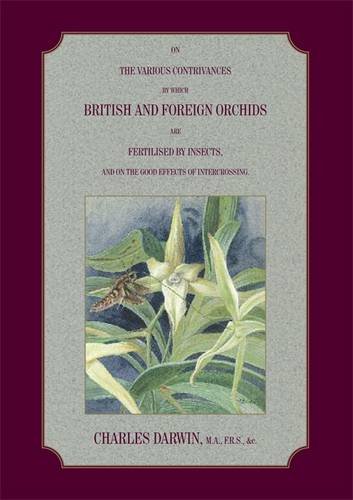
On the Various Contrivances by which British and Foreign Orchids are Fertilised by Insects was the first book Charles Darwin published after On the Origin of Species.
Conscious of criticism that, due to lack of space, he had not gone into enough detail in Origin about how complex organs might have evolved from far simpler beginnings through the process of natural selection, Darwin uses this book to explore just that. He also makes a compelling case for cross-pollination being highly beneficial to orchids.
This book is hardly a page-turner in its early chapters, which comprise numerous meticulous anatomical descriptions of different orchid species. Later, however, the book comes into its own, exploring how orchids attract insects with large, sometimes false, nectaries. Darwin also suggests the orchids might also use colour and scent to attract these pollinators. He also describes how the enlarged labellum of many orchids, which acts as a convenient and conspicuous landing-pad for visiting insects, was formed by a merging and repurposing of the flowers’ lower petal and two of its anthers.
Darwin then discusses in detail an organ unique to orchids, the rostellum, explaining how it evolved from a repurposed stigma and, in a number of species, contains a touch-sensitive trigger-mechanism that deposits stalks topped with sticky bundles of pollen at very precise locations on the bodies of visiting insects. He also shows how, as soon as these stalks are deposited on the insects, they bend forward to align the pollen bundles with the pollen-receiving stigmas of the flowers subsequently visited by the insects.
Famously, when discussing a species of foreign orchid with a remarkably long, thin nectary, Darwin also predicts the existence of an as-yet-undiscovered species of Madagascan moth with a ten- or eleven-inch proboscis. Darwin’s bold prediction, later supported and further developed by his friend Alfred Russel Wallace, was mocked by more than one biologist, but, after his death, was proved to be correct.
As Darwin explains in the introduction to this book:
This treatise affords me also an opportunity of attempting to show that the study of organic beings may be as interesting to an observer who is fully convinced that the structure of each is due to secondary laws, as to one who view every trifling detail of structure as the result of the direct interposition of the Creator.
As was so often the case, Darwin succeeds magnificently.
- Buy this book from Amazon.co.uk
- Buy this book from Amazon.com
- Unfortunately, this book is not available on the bookshop.org website.

Leave a Reply