No parsonage for Darwin!

From Charles Darwin’s Beagle Diary, on this day in 1834:

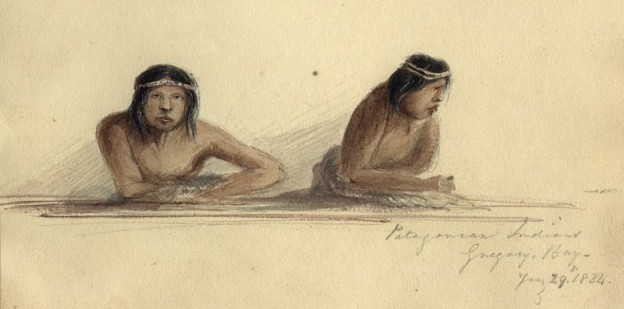
12th With very baffling winds we anchored late in the evening in Gregory Bay, where our friends the Indians anxiously seemed to desire our presence. During the day we passed close to Elizabeth Island, on North end of which there was a party of Fuegians with their canoe &c. — They were tall men & clothed in mantles; & belong probably to the East Coast; the same set of men we saw in Good Success Bay; they clearly are different from the Fuegians, & ought to be called foot Patagonians. — Jemmy Button had a great horror of these men, under the name of “Ohens men”. — “When the leaf is red, he used to say, Ohens men come over the hill & fight very much.” —

Patagonian Indians

Patagonian Indians, Gregory Bay by Conrad Martens
Cambridge University Library

If you had asked him three years earlier, I’m pretty sure Darwin would not have predicted that he would spend his 25th birthday encountering Patagonian natives and hearing horror stories about them from a Fuegian (and having a mountain named after him). He would, more likely, have predicted that he would spend it in his parsonage somewhere, maybe drafting next Sunday’s sermon.

You never know what life might hold in store for you.

Happy Darwin Day, one and all!

The HMS Beagle Olympics

As the Games of the XXX Olympiad officially commence in London later today, the good people of Much Wenlock in Shropshire can be rightly proud that their own modern version of the Olympic Games, founded in 1850, inspired Baron Pierre de Coubertin to create what was to become the world’s greatest sporting event: the Olympic Games.

Yet Much Wenlock was not the only nineteenth-century community to celebrate its own, local ‘Olympic Games’. The City of Liverpool (the world’s greatest, in my rather biased opinion) held an annual ‘Grand Olympic Festival’ from 1862–67. Far more importantly, however, the crew of HMS Beagle held their own ‘Olympic Games’ at Port Desire, Patagonia, on Christmas Day, 1833. Charles Darwin takes up the story in his Beagle Diary:

25th [December, 1833]

Christmas After dining in the Gun-room, the officers & almost every man in the ship went on shore. — The Captain distributed prizes to the best runners, leapers, wrestlers. — These Olympic games were very amusing; it was quite delightful to see with what school-boy eagerness the seamen enjoyed them: old men with long beards & young men without any were playing like so many children. — certainly a much better way of passing Christmas day than the usual one, of every seaman getting as drunk as he possibly can. —

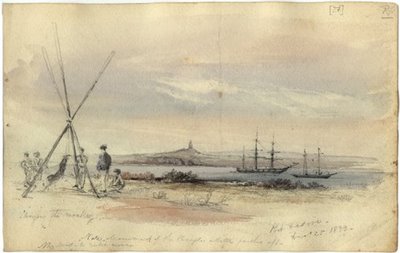
The HMS Beagle Olympics might not have had the wall-to-wall television and internet coverage enjoyed by modern sports fans (and endured by the rest of us), but fortunately the ship’s artist, Conrad Martens, was on hand to record the event for posterity:

Slinging the Monkey

‘Slinging the Monkey, Port Desire’, by Conrad Martens (1833).

Shown here is Slinging the monkey, Port Desire, the original of which now resides in Cambridge University Library. The sketch depicts HMS Beagle (L) and the Adventure (R) at anchor. In the foreground, six sailors play the naval game Swinging the Monkey, which involved hanging one of their number upside down until he was able to beat one of his taunting colleagues with a stick, after which, the two men swapped places.

Darwin was right to worry about Beagle‘s crew getting drunk on Christmas Day. At the very start of the voyage, two years earlier, the ship having been stuck in Devonport for weeks, waiting for a change in the weather, Darwin recorded in his diary:

Monday 26th [December, 1831]

A beautiful day, & an excellent one for sailing, — the opportunity has been lost owing to the drunkedness & absence of nearly the whole crew. — The ship has been all day in state of anarchy. One days holiday has caused all this mischief; such a scene proves how absolutely necessary strict discipline is amongst such thoughtless beings as Sailors are.- Several have paid the penalty for insolence, by sitting for eight or nine hours in heavy chains. — Whilst in this state, their conduct was like children, abusing every body & thing but themselves, & the next moment nearly crying. — It is an unfortunate beginning, being obliged so early to punish so many of our best men there was however no choice left as to the necessity of doing it.

History does not record which of the Beagle‘s crew won the most medals at the Beagle Olympics, nor whether they would have put much store in the motto of the modern Olympic Games: Citius, Altius, Fortius [Faster, Higher, Stronger]—although it does have a certain Darwinian ring to it.

A miserable birthday aboard HMS Beagle

A very Happy Darwin Day.

Yours truly, writing on the Beagle Project blog:

A miserable birthday aboard HMS Beagle

Sometimes even plain sailing isn’t plain sailing:

12th There has been a little swell on the sea to day, & I have been very uncomfortable: this has tried & quite overcome the small stock of patience that the early parts of the voyage left me. — Here I have spent three days in painful indolence, whilst animals are staring me in the face, without labels & scientific epitaphs. — This has been the first day that the heat has annoyed us.

Charles Darwin writing in his diary aboard HMS Beagle 180 years ago today, on his 23rd birthday. In almost five years voyaging around the world, the poor lad never really overcame his dreadful seasickness.

185 years ago today…

[Cross-posted from the Beagle Project blog]

On 22nd May, 1826, His Majesty’s Ship Beagle set sail from Plymouth on a surveying voyage to South America.

Neither Darwin nor FitzRoy were on board. This was Beagle’s first voyage. Her more famous second voyage was to begin five years later.

But her first voyage was not without incident: hardship; scurvy; several deaths; the suicide of Beagle’s captain, Pringle Stokes; his temporary replacement by Lieutenant Skyring; his official replacement by the 23-year-old Robert FitzRoy, who joined the ship at Montevideo; surveying; the discovery and naming of the Beagle Channel; the abduction of four young Fuegian natives.

The first Beagle voyage was to establish Robert FitzRoy as an able and talented ship’s captain, making him the logical choice to fulfil the same role on what was to become her far more famous second voyage. The need to return the young Fuegians to their homeland was surely a factor in FitzRoy’s acceptance of the commission; Stokes’s suicide a key factor in FitzRoy’s decision to take a gentleman companion on the voyage.

In other words, were it not for the events of the first Beagle voyage, history might have been very different.

Serendipitous juxtaposition

The following two items just came up one after the other on my RSS reader. Their juxtaposition pleased me:

Charles Darwin’s Beagle Diary: Captain Fitzroy’s Journal: Reflections following the visit to the Galapagos (2)

Striking instances of the manner in which high land deprives air of its moisture may be seen at the Galapagos. Situated in a wind nearly perennial, those sides only which are exposed to it (the southern) are covered with verdure, and have water: all else is dry and barren, excepting such high ground as the passing clouds hang upon indolently as they move northward. In a similar manner may we not conclude that western Peru is deprived of rain—since the easterly trade wind which carries moisture, and consequent fertility, to eastern Peru, is drained, or dried, as it crosses the Andes? And may we not extend this reasoning to other countries similarly situated, such as Patagonia, perhaps Arabia, and even Africa, upon whose arid deserts no moist wind blows? Currents of air, moving from ocean to land, convey vapour; but as these currents pass over high land, or even a considerable extent of low country, much if not the whole of their aqueous contents is discharged, and until such a body of air has again acquired moisture, it is found to be dry, parching, and unfavourable to vegetation.

Mick Hartley: Wet Uluru

It doesn’t often rain on Ayers Rock, but last week it did – and photographer Peter Carroll was there (via):

Ulurur659652_4712021

Photo © Peter Carroll

The Beagle entertains a royal visitor

In chapter 18 of The Voyage of the Beagle, Charles Darwin describes a royal visitor to the ship in the large, awkward shape of Queen Pomarre of Tahiti:

November 25th [1835]. – In the evening four boats were sent for her majesty; the ship was dressed with flags, and the yards manned on her coming on board. She was accompanied by most of the chiefs. The behaviour of all was very proper: they begged for nothing, and seemed much pleased with Captain Fitz Roy’s presents. The queen is a large awkward woman, without any beauty, grace or dignity. She has only one royal attribute: a perfect immovability of expression under all circumstances, and that rather a sullen one. The rockets were most admired, and a deep “Oh!” could be heard from the shore, all round the dark bay, after each explosion. The sailors’ songs were also much admired; and the queen said she thought that one of the most boisterous ones certainly could not be a hymn! The royal party did not return on shore till past midnight.

Darwin eats an excellent cat

As a former card-carrying member of the Glutton Club, Charles Darwin was pretty unsqueamish when it came to sampling strange flesh, but he did not at all relish the idea of eating calf foetus while travelling is South America. Fortunately, it turned out to be something decidedly more appetising:

We did not reach the posta on the Rio Tapalguen till after it was dark. At supper, from something which was said, I was suddenly struck with horror at thinking that I was eating one of the favourite dishes of the country namely, a half-formed calf, long before its proper time of birth. It turned out to be Puma; the meat is very white and remarkably like veal in taste. Dr. Shaw was laughed at for stating that “the flesh of the lion is in great esteem having no small affinity with veal, both in colour, taste, and flavour.” Such certainly is the case with the Puma. The Gauchos differ in their opinion, whether the Jaguar is good eating, but are unanimous in saying that cat is excellent.

How to get a large animal into a small boat

At the start of autumn, I sometimes help my farmer friend to bring her free-range beef cattle down from the local moor where they have been grazing throughout the summer. In winter, I help her to move them between various fields to ensure that they have enough grass to eat. In spring, I help return them to the moor.

Cows on moor

Some of my friend’s cattle on the local moor.

Such experiences have given me a deep contempt for cattle, which I no longer try to conceal. Semi-wild cows are unbelievably stupid and wilful creatures. No force on Earth can compel them to go where they have decided they don’t want to go—even when it is in their own best interest.

But I’ve never had to get a cow into a boat.

Fortunately, if I ever find myself in the position of needing to get a cow into a boat, I now know exactly how to do it thanks to Charles Darwin, who observed how it is done and recorded the technique for posterity in his useful animal-husbandry manual, The Voyage of the Beagle:

The road to Cucao was so very bad that we determined to embark in a periagua. The commandant, in the most authoritative manner, ordered six Indians to get ready to pull us over, without deigning to tell them whether they would be paid. The periagua is a strange rough boat, but the crew were still stranger: I doubt if six uglier little men ever got into a boat together. They pulled, however, very well and cheerfully. The stroke-oarsman gabbled Indian, and uttered strange cries, much after the fashion of a pig-driver driving his pigs. We started with a light breeze against us, but yet reached the Capella de Cucao before it was late. The country on each side of the lake was one unbroken forest. In the same periagua with us, a cow was embarked. To get so large an animal into a small boat appears at first a difficulty, but the Indians managed it in a minute. They brought the cow alongside the boat, which was heeled towards her; then placing two oars under her belly, with their ends resting on the gunwale, by the aid of these levers they fairly tumbled the poor beast heels over head into the bottom of the boat, and then lashed her down with ropes.

So now we know. Thanks, Charles.

Darwin performs a blind test… on some condors

Charles Darwin was a great experimenter. In his later life at Down House, he conducted scores of weird and wonderful experiments on pigeons, fowl, plants, seeds, dogs, his own children, you name it; he would experiment on it. But he also found time to conduct some experiments during the Beagle voyage. He even got to perform an experiment on that most iconic of South American birds, the condor.

canyon del colca - condor

Condor, Canyon del Colca, Peru (cc gudi&cris)

Darwin describes his condor experiment in The Voyage of the Beagle. He gets off to what would nowadays be thought of as a pretty bad start:

April 27th. … This day I shot a condor. It measured from tip to tip of the wings, eight and a half feet, and from beak to tail, four feet.

He then describes the range and habits of condors before getting on to his experiment on some live, captive condors:

Remembering the experiments of M. Audubon, on the little smelling powers of carrion-hawks, I tried […] the following experiment: the condors were tied, each by a rope, in a long row at the bottom of a wall; and having folded up a piece of meat in white paper, I walked backwards and forwards, carrying it in my hand at the distance of about three yards from them, but no notice whatever was taken. I then threw it on the ground, within one yard of an old male bird; he looked at it for a moment with attention, but then regarded it no more. With a stick I pushed it closer and closer, until at last he touched it with his beak; the paper was then instantly torn off with fury, and at the same moment, every bird in the long row began struggling and flapping its wings. Under the same circumstances, it would have been quite impossible to have deceived a dog.

…a classic blind test—although it seems strange to use the phrase when experimenting on the sense of smell.

Darwin goes on to observe:

The evidence in favour of and against the acute smelling powers of carrion-vultures is singularly balanced. Professor Owen has demonstrated that the olfactory nerves of the turkey-buzzard (Cathartes aura) are highly developed, and on the evening when Mr. Owen’s paper was read at the Zoological Society, it was mentioned by a gentleman that he had seen the carrion-hawks in the West Indies on two occasions collect on the roof of a house, when a corpse had become offensive from not having been buried, in this case, the intelligence could hardly have been acquired by sight. On the other hand, besides the experiments of Audubon and that one by myself, Mr. Bachman has tried in the United States many varied plans, showing that neither the turkey-buzzard (the species dissected by Professor Owen) nor the gallinazo find their food by smell. He covered portions of highly-offensive offal with a thin canvas cloth, and strewed pieces of meat on it: these the carrion-vultures ate up, and then remained quietly standing, with their beaks within the eighth of an inch of the putrid mass, without discovering it. A small rent was made in the canvas, and the offal was immediately discovered; the canvas was replaced by a fresh piece, and meat again put on it, and was again devoured by the vultures without their discovering the hidden mass on which they were trampling. These facts are attested by the signatures of six gentlemen, besides that of Mr. Bachman.

The degree to which certain birds use smell to detect food is still a controversial topic. Most birds seem to have a poor sense of smell, but others such as kiwis and certain sea birds do seem to make use of it while foraging/hunting for food. Although turkey vultures seem to have a good sense of smell, experiments have shown that it does not appear sufficiently acute to detect odours from high altitude.

167 years after Darwin performed his condor experiment, the controversy continues.

The Falklands fox: foolish dog of the south

The hapless fox from the Chiloé Archipelago wasn’t the only canid remarked upon by Charles Darwin in the popular write-up of his world tour. Amongst the others was the Falklands fox, which Darwin writes about in chapter 9 of The Voyage of the Beagle:

The only quadruped native to the island; is a large wolf- like fox (Canis antarcticus), which is common to both East and West Falkland. I have no doubt it is a peculiar species, and confined to this archipelago; because many sealers, Gauchos, and Indians, who have visited these islands, all maintain that no such animal is found in any part of South America.

Molina, from a similarity in habits, thought that this was the same with his “culpeu”; but I have seen both, and they are quite distinct. These wolves are well known from Byron’s account of their tameness and curiosity, which the sailors, who ran into the water to avoid them, mistook for fierceness. To this day their manners remain the same. They have been observed to enter a tent, and actually pull some meat from beneath the head of a sleeping seaman. The Gauchos also have frequently in the evening killed them, by holding out a piece of meat in one hand, and in the other a knife ready to stick them. As far as I am aware, there is no other instance in any part of the world, of so small a mass of broken land, distant from a continent, possessing so large an aboriginal quadruped peculiar to itself. Their numbers have rapidly decreased; they are already banished from that half of the island which lies to the eastward of the neck of land between St. Salvador Bay and Berkeley Sound. Within a very few years after these islands shall have become regularly settled, in all probability this fox will be classed with the dodo, as an animal which has perished from the face of the earth.

How the Falklands fox (also known as the Falklands wolf or warrah) got to the Falkland Islands, which lie 480km from the South American mainland, is still something of a mystery. Recent genetic analyses show that the animal’s closest living relative is the maned wolf of South America. But these analyses also indicate that the two canids’ lineages diverged over 6 million years ago—and canids do not appear in the South American fossil record until 2.5 million years ago. From this we can infer that, if absolute genetic dating is to be trusted (concerning which, I personally entertain some doubts), the two lineages most likely evolved in North America. We should expect, therefore, to find more recent ancestors of the Falklands fox in the South American fossil record. One possible candidate for such an ancestor is Dusicyon avus from Patagonia, which went extinct 6,000 to 8,000 years ago.

It is believed that the ancestors of the Falklands fox must have crossed over to the islands during the last ice age (which ended 11,500 years ago), when the lower sea-level probably caused a land-bridge between the Falkland Islands and the South American mainland. Darwin’s view was that they might have crossed to the Falkland Islands on icebergs (see below). Another, very unlikely suggestion is that the fox is descended from domesticated foxes transported to the islands by the Yaghan people of Tierra del Fuego, who used culpeos as hunting dogs. But there is no archaeological evidence that any humans visited the Falkland Islands before the British first arrived there, and, as Darwin himself pointed out (see above) culpeos are quite distinct from Falkland foxes.

Falklands Fox

The Falkland fox “Canis antarcticus” from Mammalia, Part 2 No. 1 of The Zoology of the Voyage of H.M.S. Beagle by George R. Waterhouse (Charles Darwin ed.)

En route home to Blighty aboard HMS Beagle in 1835, Darwin wrote up some Ornithological and Animal Notes from the voyage, in which he included some observations about the Falklands fox:

Out of the four specimens brought home in the Beagle, three will be seen to be darker coloured, they come from the East Isd. The fourth is smaller & rusty coloured, & is from the West Isd. — Mr Lowe, who has been acquainted with these Islands for twenty years, & who is an accurate observer of Nature, asserts that this difference between the Foxes of the two Isds is invariable & constant. He says he has long since observed it. — An accurate comparison of these specimens will be interesting. I have omitted to add that the difference was corroborated by the officers of the Adventure. —

So, perhaps the Falkland fox was actually two species living on the two main Falkland Islands. If so, it would have made another wonderful example of closely related species living on adjacent islands, as was to be the case with Darwin’s more famous examples of the Galápagos mockingbirds, tortoises and finches. Indeed, Darwin wrote about the Falkland fox again in passing in his ornithological notes, in an extremely famous passage about the Galápagos mockingbirds, in which he first questioned the stability of species:

… I have specimens [of Galápagos mockingbirds] from four of the larger Islands; the two above enumerated, and (3349: female. Albermarle Isd.) & (3350: male: James Isd). — The specimens from Chatham & Albermarle Isd appear to be the same; but the other two are different. In each Isld. each kind is exclusively found: habits of all are indistinguishable. When I recollect, the fact that the form of the body, shape of scales & general size, the Spaniards can at once pronounce, from which Island any Tortoise may have been brought. When I see these Islands in sight of each other, & possessed of but a scanty stock of animals, tenanted by these birds, but slightly differing in structure & filling the same place in Nature, I must suspect they are only varieties.

The only fact of a similar kind of which I am aware, is the constant | asserted difference — between the wolf-like Fox of East & West Falkland Islds.
— If there is the slightest foundation for these remarks the zoology of Archipelagoes — will be well worth examining; for such facts would undermine the stability of Species.

But, by the time Darwin came to edit The Zoology of the Voyage of H.M.S. Beagle, he was no longer of the opinion that the Falklands fox comprised two distinct species, commenting:

… Mr. Gray, of the British Museum, had the kindness to compare in my presence the specimens deposited there by Captain Fitzroy, but he could not detect any essential difference between them.

Had Darwin been more convinced that the Falklands fox comprised two species, he might well have given it/them more prominence in On the Origin of Species. As it was, however, the poor creature only earns a passing mention:

… as yet I have not found a single instance, free from doubt, of a terrestrial mammal (excluding domesticated animals kept by the natives) inhabiting an island situated above 300 miles from a continent or great continental island; and many islands situated at a much less distance are equally barren. The Falkland Islands, which are inhabited by a wolf-like fox, come nearest to an exception; but this group cannot be considered as oceanic, as it lies on a bank connected with the mainland; moreover, icebergs formerly brought boulders to its western shores, and they may have formerly transported foxes, as so frequently now happens in the arctic regions.

Nowadays, the Falkland fox is known by the scientific name Dusicyon australis, meaning literally foolish dog of the south—a reference to the animal’s absence of fear of humans.

Perhaps it was this lack of fear which was the beast’s undoing. For Darwin’s prophesy turned out to be tragically accurate: the once-common species was hunted by American fur traders in the 1830s, and was later persecuted by Scottish settlers wishing to protect their sheep.

It is believed that the last individual Falkland fox was killed at Shallow Bay, West Falkland in 1876.


Further reading: Alas, poor warrah… New Scientist (20-Dec-2003) [subscribers only link]